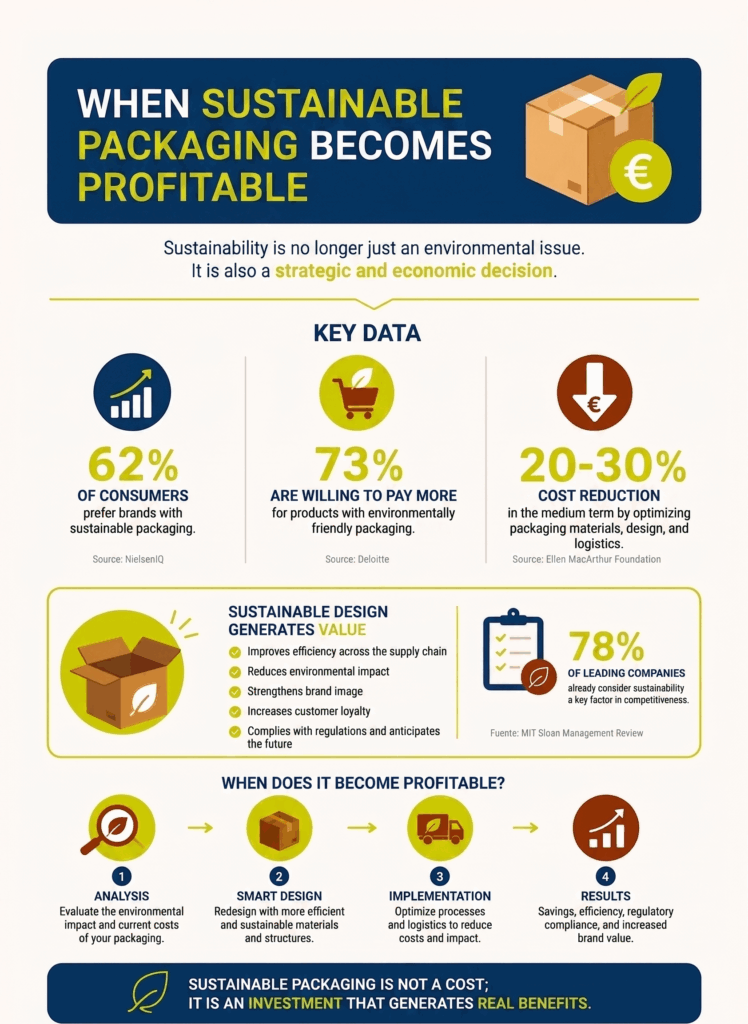
For years, sustainability was seen as an added cost. Today, the scenario has changed: compostable and recyclable packaging not only responds to social and regulatory demand, but can also become a direct driver of profitability for manufacturers.
But when does that tipping point occur, where sustainable packaging stops being “an investment” and starts becoming a growth engine?
At Coverpan, we see it every day: profitability comes when sustainability is strategically integrated into the business model, not when it is added as an extra.
Below are three key moments where sustainability starts generating real returns.
En Coverpan lo vemos cada día: la rentabilidad llega cuando la sostenibilidad se integra estratégicamente en el modelo de negocio, no cuando se añade como un extra.
A continuación, tres momentos clave donde la sostenibilidad empieza a generar retorno real.
1. When sustainable packaging opens commercial opportunities that conventional packaging can no longer access
Increasingly, brands—especially in food, cosmetics, and fresh products—base their purchasing decisions on verifiable sustainability criteria. This means that:
- Compostable packaging allows access to customers who require certifications such as OK Compost or EN 13432.
- Monomaterial recyclable packaging is a requirement for chains seeking true circularity.
- International distributors prioritize suppliers aligned with their ESG commitments.
At this stage, sustainability stops being a cost and becomes a competitive advantage that drives sales.
2. Cuando el envase sostenible reduce costes operativos en la cadena de valor
Profitability comes not only from selling more, but from producing better. Next-generation sustainable packaging—both compostable and recyclable—is designed to optimize processes:
- Sealing at lower temperatures → energy savings.
- Lighter materials → lower consumption per linear meter.
- Films with better thermal stability → fewer line losses.
- “Rapid heating” solutions → less time and energy in final product preparation.
When sustainable packaging improves industrial efficiency, the return is immediate.
3. When sustainability strengthens the brand and reduces future risks
Profitability is also measured in avoided risk. Adopting compostable or recyclable packaging before regulations require it allows companies to:
- Avoid urgent and costly changes in the future.
- Comply with eco-modulation requirements and recycling fees.
- Position themselves as reliable, future-ready suppliers.
- Increase perceived brand value among customers and distributors.
In a market where regulation is advancing rapidly, being ahead means profitability.
Conclusion: sustainability is profitable when it is a strategy, not a trend
At Coverpan, we are convinced that sustainable packaging is profitable from day one because it protects your company’s future. It allows you to stay ahead of regulations, optimize your resources, and connect with a market that is no longer turning back.
If you are waiting for the “perfect moment” to make the change, remember: profitability begins when you stop paying for the past and start investing in the future.